Next · 1 January 2027 · Chamber music concert · Baar (CH)Double bass · Lucerne

Editions / Bottesini
Bottesini
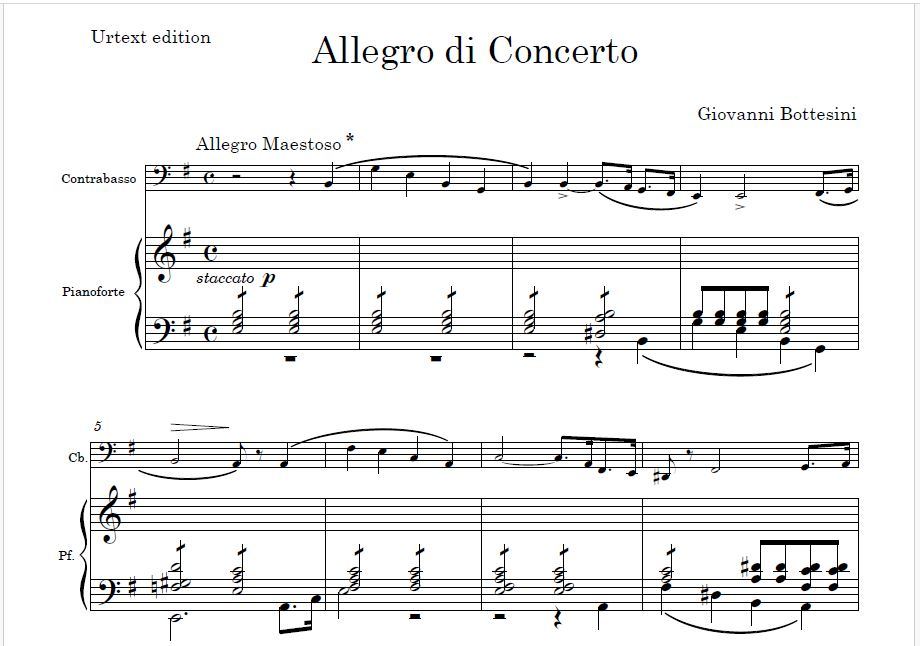
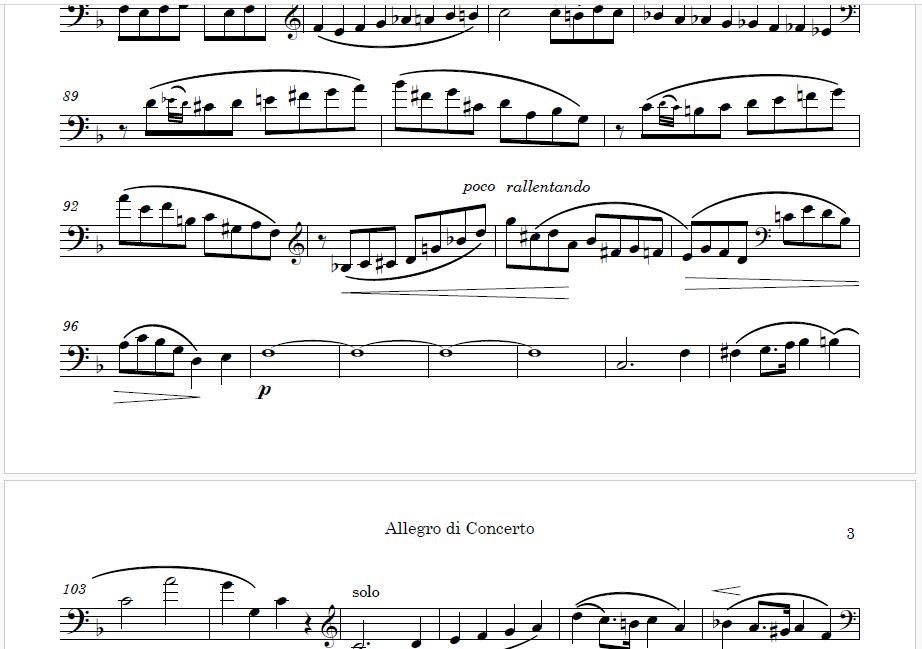
Allegro di Concerto (alla Mendelssohn) Urtext
for double bass and piano
- Included parts
- Double bass & piano
- Repertoire
- Bass & piano
- File format
- PDF | 600 dpi | 55 pages
- Scores
- double bass part and two piano scores
- Pages
- 55
- Source
- composer's facsimile, autograph of the piano score in E minor, unamended
- Release
- final, Urtext edition
- Extras
- this release includes performance practice hints
EUR12
Buy PDFEU customers pay VAT on digital products at the rate of their country. It is added automatically at checkout.
Comments
As a soloist, Bottesini often employed a scordatura on the double bass that was tuned higher than the tuning commonly used in orchestras. Because concert pitch had not yet been standardized in the 19th century, a variety of pitch levels coexisted. In addition to the frequently used pitch of A ≈ 435–440 Hz, the older Baroque pitch of A ≈ 415 Hz remained also widespread. This resulted in a difference of almost exactly a semitone. British practice, particularly in large concert settings, remained at notably higher pitch longer into the century, contributing to a brighter and more brilliant sound. For this reason, the accompaniments to many of Bottesini’s compositions exist in two versions: one at the notated pitch, and another transposed a semitone higher, the latter intended for use with lower-pitched keyboard instruments or orchestras. For the same reason many old editions include organ parts in two different pitches because organs were tuned to a different, fixed pitch than orchestral instruments, requiring transposed notation so they could play together. There is also a theory suggesting that Bottesini tuned his instrument to different pitch levels; however, there is no historical evidence for that. Bottesini often wrote stronger dynamics and clearer articulations for lower-pitched instruments – whose sound is naturally softer – to balance the difference.