BrahmsSonata in E flat major Op. 120 No 2
Next · 1 January 2027 · Chamber music concert · Baar (CH)Double bass · Lucerne

Editions / Brahms
Brahms
Sonata in E flat major Op. 120 No 2
for double bass
F tuning (cGDA)
- Included parts
- Bass part only
- Repertoire
- Bass only
- File format
- PDF | 300 dpi
- Scores
- only Double Bass | 19 pages
- Pages
- 19
- Scordatura
- in F | cGDA (this sonata is playable only in this tuning)
- Source
- composer's original text | unamended
- Recommended piano scores
- G.Henle Urtext HN987 (not included) | Bärenreiter Urtext BA10906 (not included) | Wiener Urtext UT50016 (not included) but also first release (Simrock 1895) will work fine (available in world web free of charge, however it has no bar numbers)
EUR12
Buy PDFEU customers pay VAT on digital products at the rate of their country. It is added automatically at checkout.
Recording by Božo Paradžik
BrahmsSonata in E flat major Op. 120 No 2
Comments
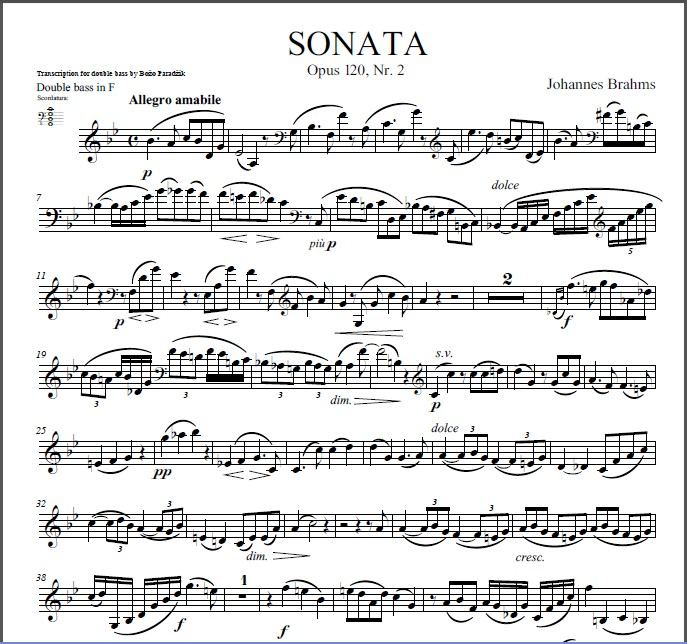
This sheet music includes my own transposition of this magic composition, the very last sonata composed by Brahms during his lifetime. This version for double bass is based on Urtext 99.9% but it features on single spots some logical and instrument specific solutions, usually at the same places where the composer’s original text slightly differs between his versions for the clarinet versus viola. In my personal opinion, there is no alternative for the scordatura in F (cGDA) for th eperformance on the double bass. Double bass sounds with this tuning surprizingly clear and present in the combination with modern piano. Technically difficult passages are also playable in this tuning. This PDF file (released in August 2021) includes also the scanned copy of my own double bass part that I have used during the work on my album “Double Bass Goes Brahms”. My part was an early version and it contains some misprints and minor errors, also wrong octaves. But I hope some of my fingerings and bowings will be useful for the difficult passages. The fingerings and especially bowings haven’t been entered and written by myself consequently everywhere. Helpful info for the fingerings: I am using the positions with strict order of the fingers (usualy chromatic order whenever possible, but if it isn’t useful, the position is sometimes larger). In the lower positions I use often 4-fingers system, that covers three halftones. I never use “floating” distances within the same position. The fingering marks are, if single, usually entered only at the moment when shifting happens (the marked fingering it is the first tone of the next position). For frequent fingering marks (tone by tone) I have usually added the brackets to clarify which tones belong within the same position.