Next · 1 January 2027 · Chamber music concert · Baar (CH)Double bass · Lucerne

Home / About
Instruments, strings & bows
As I am frequently asked about the instruments, strings, and bows I use, I have compiled the most relevant information about my personal equipment here.
Instruments
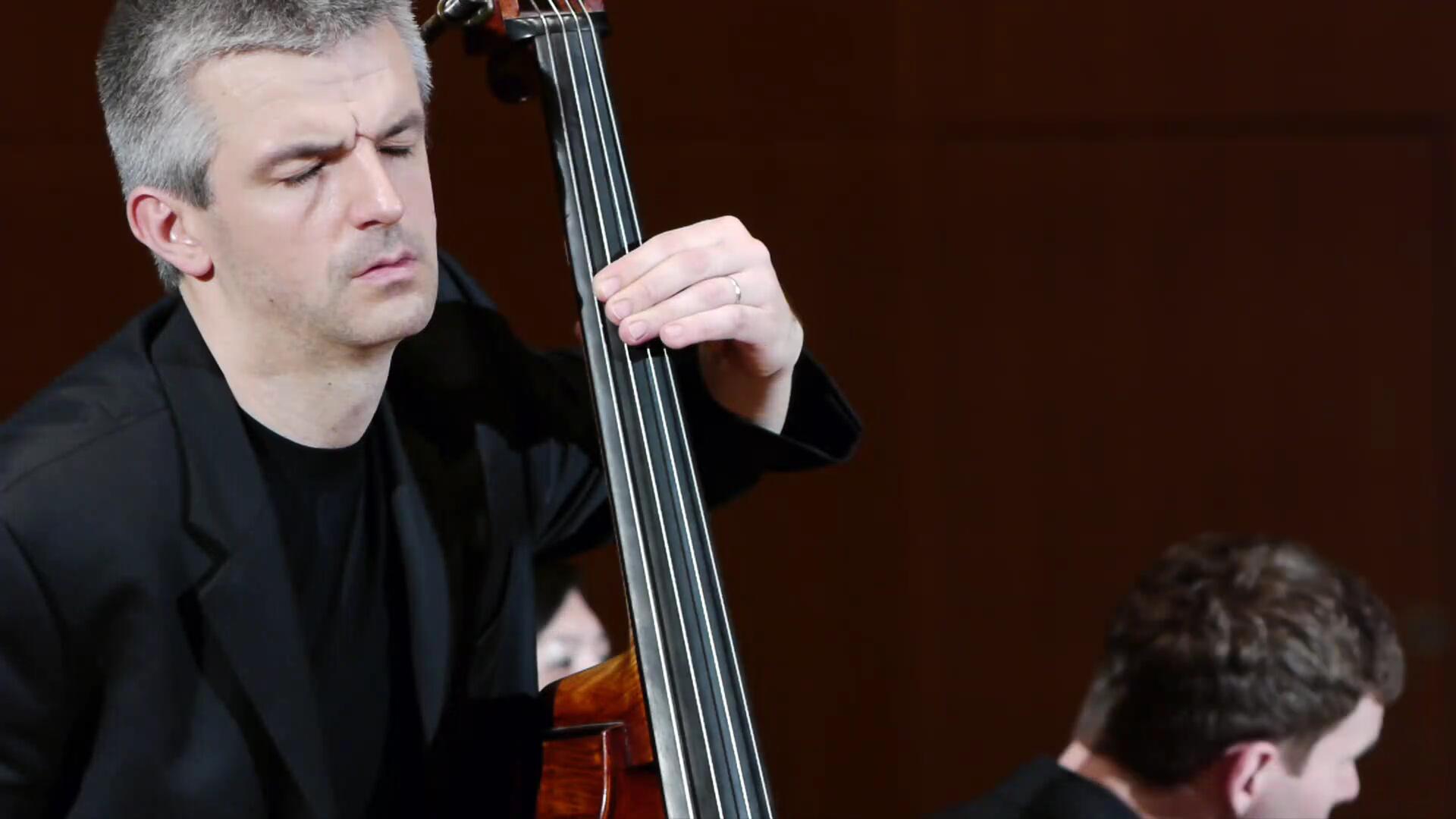
Until 2000, I played an instrument built around 1780–1790, possibly by a member of the Kloz family. Since 2000, I have frequently played an instrument by Derek High, built in 2000 and specifically designed with tonal characteristics suited to solo playing, in contrast to historical double basses. As I regularly perform works requiring three different scordatura tunings, I need both of these instruments on a regular basis. In addition, I also play a 1788 double bass made by the renowned Prague master Carolus Hellmer.
Strings
Since 2010, I have used almost exclusively hand-made gut strings by the Berlin-based string maker Gerold Genssler. I have also occasionally used his strings with a synthetic core. In 2019, the maker largely discontinued the use of gut and switched to silk cores, which behave in a very similar way. These strings have considerably lower tension and therefore place significantly less strain on the instrument – their overall tension is approximately 25–30% lower than that of commonly used steel-core strings. They also have an exceptionally long lifespan and retain their tonal characteristics over many years. The first set of gut strings is still on my five-string instrument and has been performing excellently since 2011.
For my Hertl Miniatures project, I temporarily used one of the prototypes and the first model of the Tempera strings. I no longer use these strings.
Bows
Since 1993, I have played exclusively with bows made by the bow maker Milan Oubrecht. His finely crafted bows possess distinct tonal characteristics, each suited to a particular register – ranging from the darkest-sounding bow, ideally suited to the lowest register, to bows producing a crystal-clear and precisely defined sound in the highest register. Depending on the repertoire and the acoustics of the concert hall, I select the bow best suited to the particular musical task.
Rosin
For my own playing, I prefer rosin that is somewhat harder and less sticky than the types commonly marketed for double bass. I therefore usually fuse a standard violin rosin with one of the commonly used, low-dust double bass rosins until I achieve the desired consistency.
Scordatura
Until 2004, I played, like most double bassists, in fourths tuning, either without transposition (“orchestral tuning”) or transposed in D (“solo tuning”). Since 2005, I have increasingly followed a different approach, making greater use of the higher tunings already used during the Baroque period. Most frequently, I use the F tuning (c, G, D, A with a high C string), and occasionally the G tuning (d, A, E, B with a high D string). These higher tunings transform the characteristic sound of the double bass into a natural baritone voice. They produce a more clearly defined and overtone-rich sound that carries more effectively in a concert hall. From an acoustic perspective, they therefore offer a significant advantage and are better suited to solo playing than lower tunings.
Scores
As there is virtually no original repertoire for double bass in higher tunings, I have successfully studied and performed a number of works by predominantly world-renowned composers and published them as scores – generally without altering their original form or key. Almost all of the works I have performed have been prepared using a professional notation software. Most of these scores will gradually become available in my online shop, with the catalogue continuously expanding.